Advanced Practice in MOUD Care
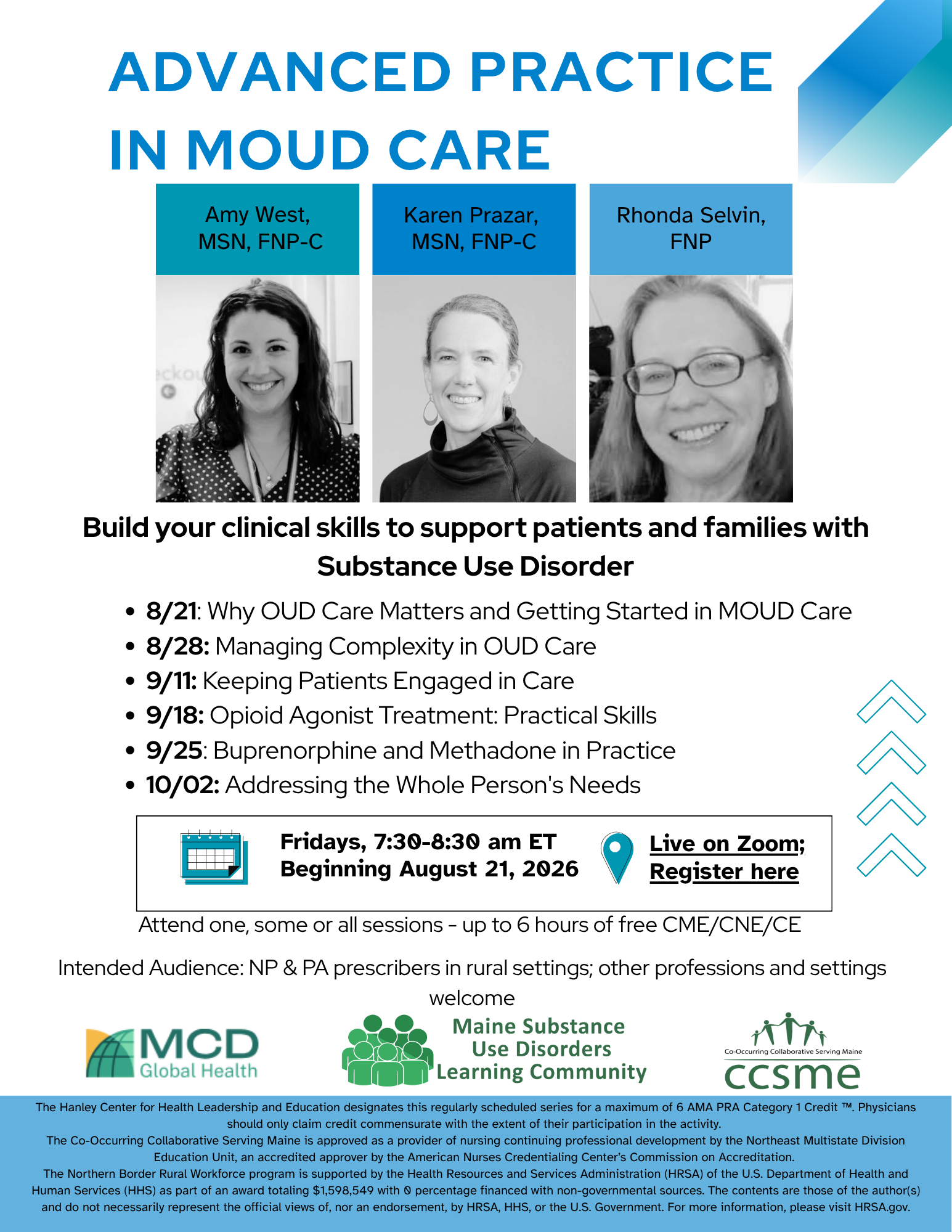
This skill-building educational series will provide nurse practitioners, P.A.s, and other care team members in rural settings with the knowledge and skills to care for people with opioid use disorder and other substance use disorders. Focusing on practical skills using a combination of lecture and interactive case discussion, participants will learn how to integrate MOUD care into rural, clinical practice, discuss current recommendations and best practices for MOUD treatment, and apply knowledge to their own cases. This course is intended for practitioners who are new to MOUD care and those with MOUD care experience who are looking to build and expand their skillset.
Nurses who are interested in applying for the CARN certification may find this course useful in preparation for the certification process.
Overall Objectives: Participants will…
- Increase knowledge of integrating MOUD into rural clinical practice.
- Strengthen confidence and motivation to treat patients with OUD/SUD.
- Explore practical clinical strategies through case vignettes and discussion.
Intended audience: NP/PA prescribers in rural areas (other professions also welcome), who are interested in learning more about providing care for people with OUD, including medication for OUD.
Dates: Fridays, 7:30-8:30 am – 8/21/26, 8/28/26, 9/11/26, 9/18/26, 9/25/26, 10/2/26
Topics:
8/21: Why OUD Care Matters and Getting Started in MOUD Care
8/28: Managing Complexity in OUD Care
9/11: Keeping Patients Engaged in Care
9/18: Opioid Agonist Treatment: Practical Skills
9/25: Buprenorphine and Methadone in Practice
10/02: Addressing the Whole Person’s Needs
Participants can choose to attend some or all sessions. For the optimal learning experience, participants are encouraged to participate in the whole series.
Presenters:
-Amy West, FNP-C
-Karen Prazar, FNP-C
-Rhonda Selvin, FNP-C
CME/CNE/CEs
- Participants may receive up to 6 hours of continuing education based on participation
Continuing Nursing Education:
The Co-Occurring Collaborative Serving Maine is approved as a provider of nursing continuing professional development by the Northeast Multistate Division Education Unit, an accredited approver by the American Nurses Credentialing Center’s Commission on Accreditation.
Nurses and Nurse Practitioners will be awarded a certificate for up to 6 CNE hours, commensurate with participation in the activity.
Continuing Medical Education:
This activity has been planned and implemented in accordance with the accreditation requirements and policies of the Accreditation Council for Continuing Medical Education (ACCME) through the joint providership of the Hanley Center for Health Leadership and Education and CCSME. The Hanley Center for Health Leadership and Education is accredited by the Maine Medical Association Committee on Continuing Medical Education and Accreditation to provide continuing medical education for physicians.
The Hanley Center for Health Leadership and Education designates this regularly scheduled series for a maximum of 6 AMA PRA Category 1 Credit ™. Physicians should only claim credit commensurate with the extent of their participation in the activity.
*Physician Assistants and Nurse Practitioners will be awarded a certificate of participation with a maximum of 6 AMA PRA Category 1 Credit ™
Other Continuing Education:
– Up to 6 contact hours for social workers, licensed clinical professional counselors, and behavioral health professionals.
– Up to 6 contract hours for CHES/MCHES. CCSME is a designated provider of continuing education contact hours (CECH) in health education by the National Commission of Health Education Credentialing, Inc.
– Up to 6 contact hours for Drug and Alcohol Counselors. This course has been approved by Co-Occurring Collaborative Serving Maine (CCSME), as a NAADAC Approved Education Provider, for 6 educational credits. NAADAC Provider #324712, CCSME is responsible for all aspects of the programming.
Funding disclosure:
The Northern Border Rural Workforce program is supported by the Health Resources and Services Administration (HRSA) of the U.S. Department of Health and Human Services (HHS) as part of an award totaling $1,598,549 with 0 percentage financed with non-governmental sources. The contents are those of the author(s) and do not necessarily represent the official views of, nor an endorsement, by HRSA, HHS, or the U.S. Government. For more information, please visit HRSA.gov.